

 2026-10-12
 ️176 Views
 ️Vladimír Michl
Will vibecoding lead to the death of the software industry?
Watching today's fascination with AI-powered app cloning evokes a strong sense of déja vu. It reminds me of the situation about ten years ago, when Chinese clones of AutoCAD appeared on the market.
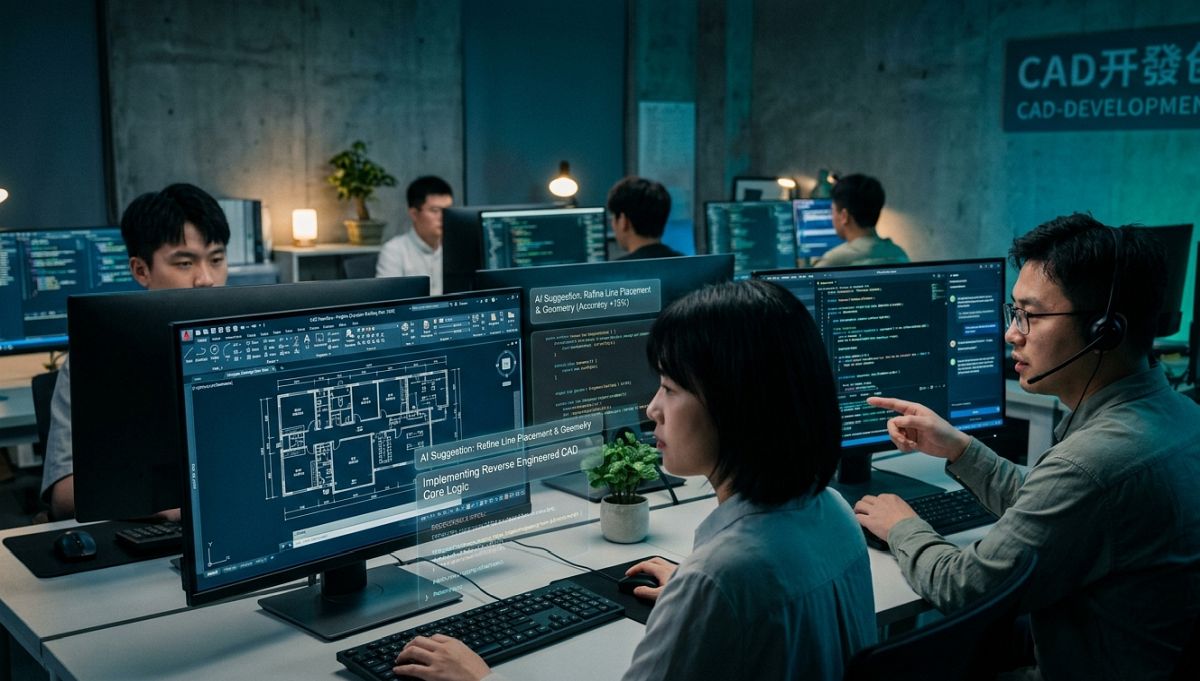
A headline claiming that “AI will kill the software industry” or that “any high school student can now program their own Photoshop in an afternoon” is guaranteed to generate clicks. The latest examples of rapid app development using generative artificial intelligence - such as the work of Brandon Thomas and his Crafting Apps (Artcraft), where functional clones of Adobe’s graphic tools are created at an unprecedented speed - are therefore a real treat for the media.
Seeing how AI can “tinker together” the user interface and basic mechanisms of a complex graphics editor in just a few hours is certainly impressive. But before we start writing obituaries for software giants, let’s slow down a bit.
We've been through this before, just with different technology
Observing today’s fascination with rapid application cloning evokes a strong sense of déja vu. It’s reminiscent of the situation approximately ten years ago, when Chinese and other AutoCAD clones appeared on the market.
Only in this case, it wasn’t artificial intelligence behind it, but hordes of low-cost developers. They relied partly on reverse engineering, partly on copied concepts, and partly - unfortunately - on source code obtained without authorization - as, in fact, the trial of ZWSOFT demonstrated, for example. The resulting clones were very similar to today’s “DIY” vibecoded AI applications: the software looked almost identical, the buttons were in the same and right places, and the basic functions worked as expected. And all of this, seemingly, at a fraction of the cost.
However, taking a step back, it’s worth asking ourselves a fundamental question: Is this really the right goal?
Where has innovation gone?
Does any field really advance when someone uses new tools to imitate an existing product? And it doesn’t have to be just a software product - feel free to imagine your own product here - we are all creators and makers. Was this the “creative” vision with which we looked to AI?
The main objective and ambition of artificial intelligence in industry was supposed to be:
- Accelerating the journey from the original idea to realization.
- Creation of higher-quality, more reliable, and more innovative products.
- Opening up new possibilities that were previously not technically feasible.
And where is the innovation in product clones? If we use AI only to copy what has already been working on the market for decades, there’s a complete lack of creativity. As a demonstration of technological progress, coding speed, and the dramatic reduction in the cost of prototyping, it’s an excellent exercise. However, it should be merely the first step. The goal for the future should perhaps be to create something new and better, not just to produce “almost-good-enough” imitations.
Why reports of the death of the software industry are premature
The rise of AI is undoubtedly transforming software development in a fundamental way - for better or for worse. We’re seeing a remarkable democratization of development, which significantly lowers the entry barrier for creating your own software. Writing code is no longer the exclusive domain of a small group of specialists.
However, a successful software product depends on far more than just the speed and cost of writing the initial code. Full-fledged software development for the professional sphere requires incomparably more:
- In-depth knowledge of the industry and processes: An understanding of the real-world, day-to-day work of future users, its pitfalls, barriers, dead ends, and habits.
- Anticipating trends: A professional creator cannot simply fulfill the wishes on the current customers' wish list (users are usually quite conservative). He must have his own long-term vision and conduct research into where the entire industry is headed.
- Quality and security: Thorough quality assurance (QA), reliability, cybersecurity solutions and resilience, and compliance with strict industry standards and certifications.
- Infrastructure and resources: Operation of robust cloud and AI services, guaranteed availability, extensive technical support, an API platform for add-on developers, MCP servers, an active community, marketing and a sales network.
And you can't just easily get around these assets by cloning them. Fortunately, because who would even want to invest in an industry where a couple of guys with AI can just copy your product at any time...
Developing your own “AutoCAD” or “Photoshop” over a weekend is technically possible today thanks to AI. Getting hundreds of thousands of professionals to automatically rely on such a product for their livelihood, the fate of their own companies, daily routines and critical data - that’s an entirely different discipline.
Yes, AI has put an incredibly powerful brush in our hands. But whether we use it merely to trace old monitors or to paint entirely new worlds depends entirely on our own ingenuity.
 discussion
