

 2026-10-20
 ️72 Views
 ️Vladimír Michl
When programs communicate through agents: The future of multi-tool CAD design
Imagine an ecosystem where applications such as Revit, Inventor, Fusion, or Rhino do not transfer raw data but communicate with each other through specialized AI agents. Autodesk Assistant becomes the chief orchestrator of these processes, coordinating changes across disciplines in real time and in the background.

The traditional method of data exchange in the architecture, engineering, and construction (AEC) and manufacturing (MFG) sectors is reaching its limits, and is hindering productivity. Although exchange formats such as IFC have done a tremendous amount to promote openness in the industry, the process of constantly exporting, importing, and manually coordinating changes among teams - including manufacturing and construction teams - remains inefficient. The real revolution, however, does not lie in some new file format. It comes with agent-based AI and a new architecture, where specialized software does not transport raw and voluminous design data but communicates directly with one another through autonomous AI agents. The main conductors of this ecosystem will be “AI orchestrators” - coordination tools such as the upcoming standalone Autodesk Assistant, based on the cloud-based Autodesk Platform Services (APS).
From static files to a dynamic context: MCP and Autodesk Platform Services
The fundamental problem with large language models (LLMs) in engineering practice is their inability to calculate precise geometry and their tendency to hallucinate. An LLM alone cannot simply design a precise engineering component or calculate the deflection of a beam, but it excels at logical reasoning, data synthesis, and step-by-step planning.
The Model Context Protocol (MCP) - an open standard that enables LLMs to access external data sources and enterprise tools securely, bidirectionally, and in a structured manner - thus becomes a key bridge. Within the Autodesk ecosystem, the Autodesk Platform Services (APS, formerly Forge) cloud environment serves as the ideal infrastructure for MCP servers. As a result, Autodesk Assistant does not have to “guess” the properties of CAD elements in a design stored in the cloud. Through the standardized MCP interface, it sends a deterministic query to the APS Data Management API, retrieves precise geometric and descriptive data from the cloud, and passes it on to specialized microservices - such as the cloud-based geometric kernel or structural solvers. As a result, the AI orchestrator maintains the overall context of the project (and the industry), while the calculations are performed by native code.
Multi-agent ecosystems powered by Autodesk Assistant
In modern design practice, we rarely work in just one program. An architect sketches organic shapes in Rhino, a designer or structural engineer models in Autodesk Revit, and a mechanical engineer designs HVAC components in Autodesk Inventor. Instead of people having to go through the hassle of transferring files and dealing with different file formats, multi-agent orchestration - managed by the centralized Autodesk Assistant tool - takes over.
Let's imagine an architecture in which each application has its own specialized "sub-agent":
- Revit Agent (managing Revit Design Automation within APS)
- Inventor Agent (communicating via the Inventor API)
- Central Orchestrator (e.g., the future Autodesk Assistant)
If a major architectural change is made to the design in Revit, the Revit Agent notifies the Autodesk Assistant. Acting as an orchestrator, the Assistant immediately determines that the change in the location of the load-bearing wall will affect the HVAC routing designed in Inventor. Instead of merely displaying a clash (Clash Detection), Autodesk Assistant can autonomously instruct the Inventor Agent to run a parametric script, adjust the duct routing, and relocate the hangers. The entire coordination process takes place in the background, programmatically, and in real time.
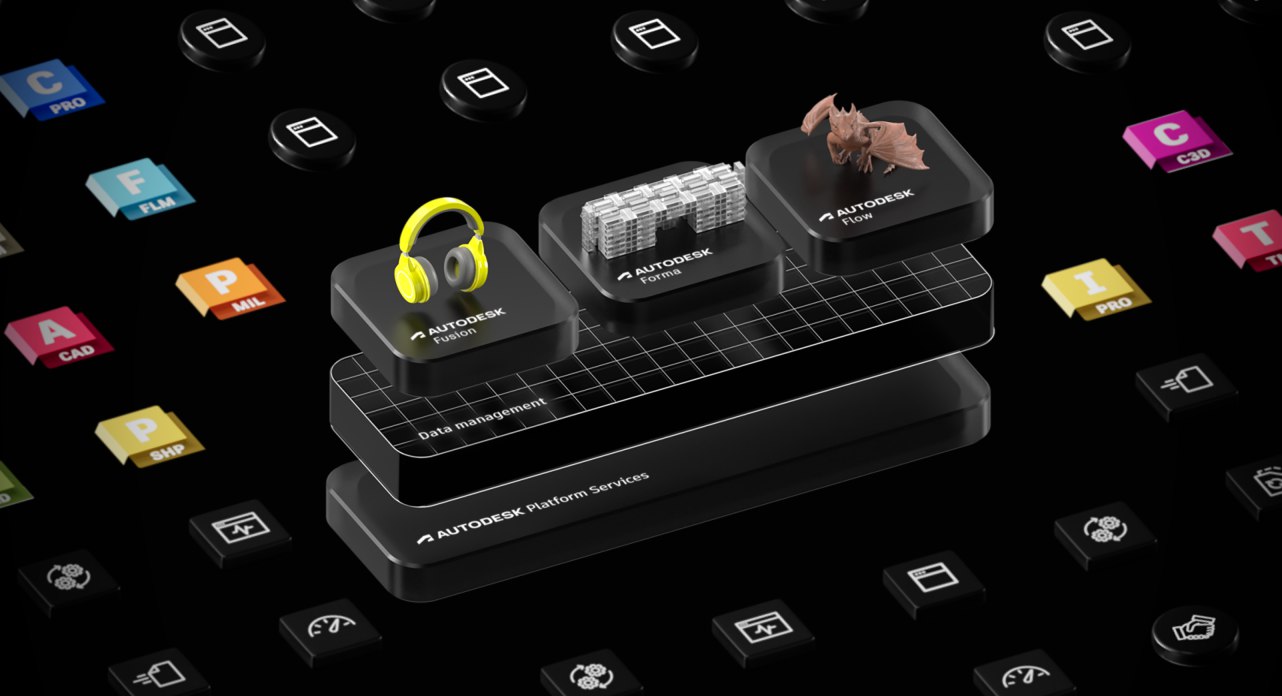
The new generation of Autodesk Assistant
The next-generation Assistant is built on three priorities:
- Understanding what needs attention. The Personal Pulse feature identifies priority issues and insights across projects. The Assistant Spaces feature provides teams and their agents with an environment focused on exploring a problem, collaborating on a solution, and tracking its subsequent impacts.
- Act across workflows. Assistant connects Autodesk’s specialized AI in the areas of design, engineering, and creativity with the precise capabilities that experts rely on when simulating, manufacturing, and implementing their projects, and - through natural language and voice interaction - transforms the user’s intent into reliable and verifiable results.
- Bring your own intelligence (BYOI). The Assistant Builder enables customers to connect their own AI agents, tools, and services from trusted partners with the context of Autodesk projects.
Based on these principles, Autodesk AI Orchestrator evaluates models according to the needs of a specific task, including assessments of accuracy, speed, safety, and cost, which makes it possible to draw on various forms of intelligence without having to rely on a single model for every problem.
Real-world example: Data-driven validation for incompatible formats
What does it look like when AI agents tackle a real-world engineering problem? Let’s imagine a situation where an investor provides the project specifications in Excel, the local building authority issues the zoning plan in PDF, and the design firm’s standards are stored in JSON format. For a human, this means hours of manual comparisons.
For a multi-agent system, this is a task that takes just a few seconds. Autodesk Assistant loads these incompatible sources, uses specialized agents with OCR and an LLM parser to extract rules, and creates a unified validation matrix. It then autonomously tests the cloud-based Revit model against these rules using the APS Model Checker.
Below is a conceptual example of how such an AI orchestrator communicates via the MCP interface with Autodesk’s backend to check and correct the thickness of an insulated wall based on a requirement from an external PDF file (you can, of course, also submit a similar request manually using an AI prompt):
// Example of a JSON-RPC request (Prompt) from Autodesk
Assistant to the Revit MCP server
{
"jsonrpc": "2.0",
"method": "tools/call",
"params": {
"name": "validate_and_update_wall_insulation",
"arguments": {
"urn": "dXJuOmFkc2skb2JqZWN0czpvcy5vYmplY3Q6bXktYnVja2V0L21vZGVsLnJ2dA",
"wall_type_id": "Wall-Ext-Ins-01",
"required_u_value": 0.18,
"regulatory_source": "PDF_Building_Regulations_2026.pdf"
}
},
"id": 42
}
Or here’s another example: A machine manufacturer receives an email from a supplier alerting them about a disruption in motor shipments. This email is imported into the shared Autodesk PLM workspace. The Assistant identifies the impact on the product, proposes a specific workaround (an available alternative motor that meets the specifications), summarizes the impact on production and cost based on the specifications, and helps the team update the bill of materials and draft a change order. Here, a supply chain issue is transformed into a technical problem that leads to a change in product specifications, which in turn requires people to take action. A long chain of consequences, a broad context, and a quick proposal for human decision-making.
How does this work in the real world? Real examples
But the deployment of agent-based systems is no longer the stuff of science fiction. Leading global engineering and architecture firms have already integrated these concepts into their processes:
- Mott MacDonald & ARUP (Automated Coordination of Infrastructure Networks): These multinational engineering firms use AI agents connected to cloud APIs to automatically resolve conflicts between linear utility network projects and existing underground infrastructure. The agent detects pipeline conflicts in an Autodesk Civil 3D model, autonomously evaluates slope criteria based on local regulations, and uses scripts to reroute the utility network before the designer even opens their morning email.
- Zaha Hadid Architects (ZHA / generative design): The firm, known for its use of complex geometry, has deployed multi-agent orchestration to optimize facade panels. Agents communicate between the Rhino/Grasshopper and Autodesk Revit environments. An LLM agent coordinates the process: it simultaneously tests the structure’s static properties, solar exposure, and material cost, while autonomously adjusting Revit family parameters to achieve both the aesthetic intent and manufacturability.
Strategic guide for IT: How to prepare your office infrastructure for the era of agents
If your design or engineering firm is to benefit from these technologies, your current IT infrastructure - which relies on local file servers and heavy workstations - will not be sufficient. Transforming your infrastructure will require four key steps:
- Migration to a “Cloud-First” data architecture: AI agents require immediate, programmatic, low-latency access to data. Local disk sharing (NAS/SAN) via VPN is impenetrable for AI agents. The key to success is migrating project data to cloud-based Common Data Environment (CDE) platforms such as Autodesk Forma and fully leveraging Autodesk Platform Services (APS). Data must be accessible via standardized REST APIs.
- Data standardization and semantic modeling (strict BIM/CAD standards): In order for an AI agent to read and edit a model, your internal standards (nomenclature for layers, parameters, families, and shared parameters) must be 100% consistent. Implement strict templates and machine-readable data standards (e.g., exported specifications in JSON/XML) from which agents can derive validation rules.
- Implementation of the integration layer (MCP-ready): Start building internal microservices. Wrap your existing corporate Python scripts, Dynamo scripts, or internal C# add-ins into web APIs (e.g., using AWS Lambda or Azure Functions). This will prepare them so that the Model Context Protocol (or MCP server) can call/invoke them in the future as “tools” for Autodesk Assistant.
- Ensuring cybersecurity at the API level: Agent AI will have the right to autonomously modify project data. Does that sound scary enough? The IT department must transition to a Zero Trust architecture and strictly manage access rights (OAuth 2.0) for individual AI entities. An agent may only have write access to those parts of the model for which it is responsible, and every autonomous change must be logged as part of version control (Audit Trail) in the CDE system.
A future without manual routine tasks
There is a shift from software as a mere digital drawing board to an ecosystem where the engineer defines the intent, rules, and boundary conditions. A network of specialized agents takes care of the rest. By positioning Autodesk Assistant as the orchestrator, and opening its API to agent-based workflows, Autodesk ensures that interoperability is no longer a problem caused by incompatible files. It becomes a seamless conversation between intelligent agents that saves time, eliminates human error, and pushes the boundaries of what we can design, manufacture, engineer, and build.
 discussion
